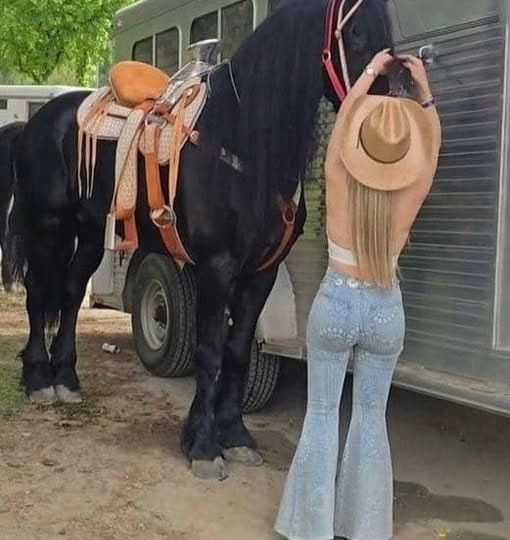

In the world of investigative journalism, we often go looking for the “big” story—the scandals, the systemic collapses, the grand tragedies. But after a decade on the beat, I’ve learned that the most profound shifts in the human condition usually happen in the quietest of moments. For one woman, a routine afternoon trail ride—an activity she had long utilized as a therapeutic escape from the cacophony of modern life—unexpectedly became the catalyst for a marital reckoning she never saw coming.
It began with the sensory details that every rider knows: the rhythmic cadence of hooves on packed earth, the filtered sunlight dancing through a canopy of oak and pine, and the cool breath of the wind. It was a scene of such cinematic serenity that she felt compelled to capture it. She snapped a photo from the saddle, intending it as a digital olive branch to her husband—a “wish you were here” gesture to let him know he was on her mind even in her solitude.
She didn’t realize she had also photographed a ghost.
The Catalyst: A Set of Initials
The image featured the horse’s equipment, including a set of initials burned into the leather of the borrowed saddle. To her, they were mere utilitarian markings, a detail of the tack she hadn’t given a second thought. But when the photo reached her husband’s phone, the response was not the playful acknowledgment she expected. Instead, a chilling distance settled over their digital communication—the kind of atmospheric shift that makes the stomach tighten with an intuitive sense of dread.
Upon her return home, the air was heavy. The silence wasn’t the peaceful kind she’d found on the trail; it was a weighted, defensive quiet. Eventually, the question came—low, vulnerable, and stripped of accusatory heat. He wanted to know about the initials. He wanted to know who they belonged to and why they had been omitted from the day’s narrative.
The Anatomy of Insecurity
As a journalist, I’ve seen how symbols can hold more power than the objects themselves. In this case, the initials weren’t the problem; it was the “quiet fear” they ignited. For her husband, those letters represented a doorway to a past he felt excluded from—a version of his wife shaped by experiences, relationships, and histories that predated their union.
It wasn’t a matter of suspicion regarding her current fidelity, but rather a profound insecurity about the “shadows of the past” that can inadvertently slip between a couple. It was a reminder that even in the closest of marriages, there are corners of a partner’s life that remain unexplored, and for him, those carvings were a stark reminder of his own perceived displacement.
The Pivot: From Defense to Dialogue
The easy path—the one many couples take—would have been defensiveness. She could have brushed it off as “crazy” or “insignificant.” Instead, they made a tactical choice to lean into the discomfort. What followed was an agonizingly honest conversation that moved past the saddle and into the bedrock of their relationship.
They delved into territories they thought they had mapped years ago:
-
Past Traumas: They discussed old heartbreaks and the fragile architecture of trust they had both struggled to build.
-
The Power of Memory: He admitted that the image had startled a long-buried reflex, a realization that unacknowledged memories still hold a residual charge.
-
The Shield of Silence: She confessed to her own habit of staying quiet to avoid “unnecessary conflict,” realizing that her protective silence had unintentionally created a vacuum where misunderstanding could thrive.
The Editorial Verdict: Trust as an Evolving State
This incident serves as a poignant case study for any long-term partnership. It reinforces the journalistic truth that communication isn’t just a “soft skill”—it is an essential survival tool. Trust is not a static trophy one wins and puts on a shelf; it is a living, breathing entity that requires constant recalibration.
The initials remain on that saddle, but they no longer function as a barrier. The couple reached a new “operating agreement”: a commitment to voice doubt, fear, and confusion in real-time rather than letting assumptions metastasize into resentment.
Looking back, the trail ride was a success, though not for the reasons she originally thought. It didn’t just clear her mind; it cleared the air. It proved that in the architecture of a marriage, the smallest details can reveal the biggest truths. They didn’t just choose each other on their wedding day; they chose each other again in the living room, opting for the “uncomfortable honest” over the “comfortable distant.”
Ultimately, love isn’t strengthened by the absence of insecurity, but by the courage to face those insecurities together—even when they are as small as a few letters carved into old leather.